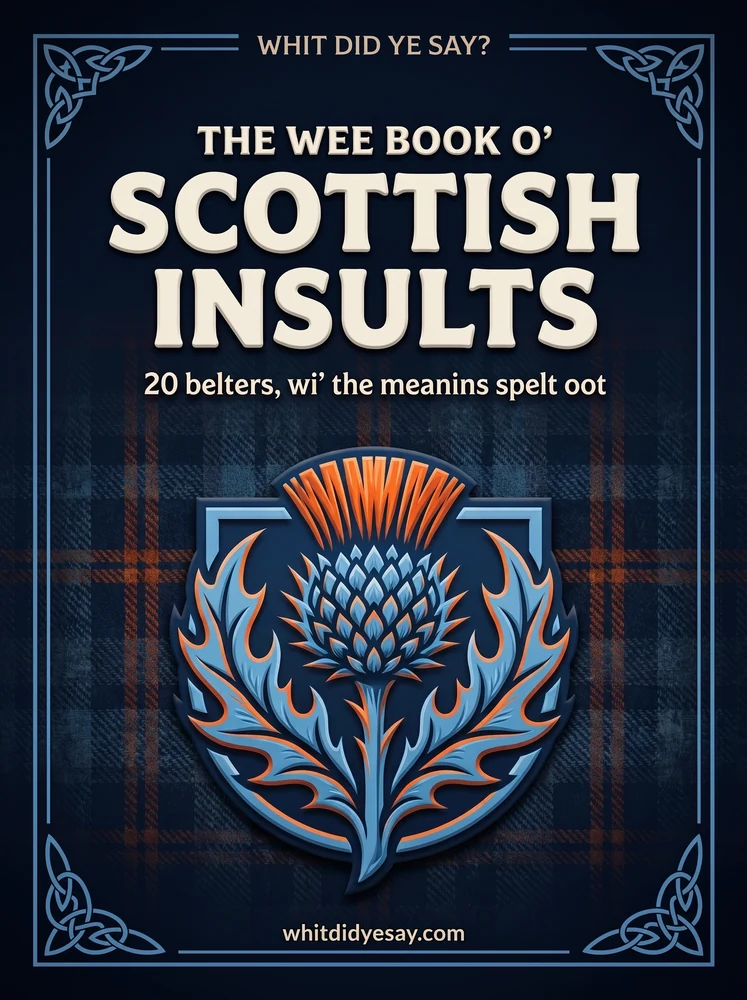
The insult is often a performance
A Scottish insult rarely lives on the word alone. It arrives with timing, facial expression, rhythm and a social contract between speaker and listener. A word like “numpty” can be a gentle tap on the shoulder when said with a grin, but it can harden when the voice drops and the patience disappears. This is why Scottish insults fascinate people outside Scotland. They look simple on a list, yet the real meaning often sits in the delivery. The insult is a performance, and the audience usually knows whether they are meant to laugh, apologise or get out of the road.
Affection and aggression share a wall
One of the strange gifts of Scottish patter is the way affection and aggression can stand right next to each other. A pal can call another pal a “wee rocket” and mean it as a fond description of daft behaviour. The same phrase, used in traffic or after a pub argument, can carry a sharper edge. Context is everything. Scottish humour often tests closeness by using mock abuse, but it also relies on reading the room. If the relationship is not there, the joke can collapse quickly. This is why learners should treat insults as culture, not just vocabulary.
Sound matters as much as meaning
The best Scottish insults have sound built into them. “Bawbag” has a blunt comic shape. “Walloper” rolls forward like a verdict. “Eejit” is short enough to land immediately. “Roaster” feels warm, ridiculous and dismissive all at once. These words work because they are easy to say with force and easy to exaggerate. Scottish speech often carries strong rhythm, and insults take advantage of that musical quality. The result is language that feels dramatic even when the meaning is fairly ordinary.
The scale of severity
Not every Scottish insult is equal. Some words are everyday banter and some should be handled carefully. “Numpty” usually sits at the mild end: someone has done something foolish, but nobody is calling for a public inquiry. “Bawbag” is stronger and more colourful. “Weapon” can be comic, but it can also sound genuinely dismissive. The important lesson is that Scottish insults operate on a scale of warmth, frustration and contempt. Learners should start with mild words, listen to how Scots use them, and avoid firing the spicier stuff at strangers.
Why tourists love them
Visitors often fall in love with Scottish insults because they reveal a national style of humour: dry, quick, self-aware and suspicious of anyone taking themselves too seriously. The best insults puncture ego. They say, in effect, “calm doon, yer no that special.” That spirit makes Scottish insults useful in comedy and online culture. They are expressive without needing long explanation. A single well-placed word can describe a person, a decision, a political speech or a catastrophic attempt at parking.
Learning without becoming a caricature
There is a danger in learning Scottish insults from lists alone. Without pronunciation and context, the learner can sound like they are doing a costume version of Scotland. The better approach is to learn the meaning, hear the audio, understand the tone, and practise with phrases that are clearly playful. Whit Did Ye Say? is built for that balance. It gives the word, the translation, the sound and the surrounding patter so users can enjoy the humour without flattening it into stereotype.
Insults as social storytelling
Scottish insults often tell a tiny story. Calling someone a “roaster” suggests a pattern of behaviour, not just one mistake. Calling someone a “heid-the-baw” paints a picture before the conversation moves on. These phrases compress judgement, humour and observation into a memorable label. That is why people share them. They are portable wee stories, perfect for group chats, captions and the kind of friendly slagging that keeps communities laughing.
How to use them responsibly
The safest rule is simple: punch sideways with friends, not downward at strangers. Use Scottish insults when the relationship can hold the joke, when the tone is obviously playful and when the target is behaviour rather than identity. If in doubt, keep it mild. Scottish patter can be wonderfully sharp, but the best speakers know when to stop. A good insult should leave people laughing, not wounded.
Why the app includes 123 of them
The insult collection in Whit Did Ye Say? exists because humour is a major part of how language is remembered. A funny phrase sticks. Add real voice audio and it becomes even more memorable. The app lets users hear, learn and share Scottish insults while also connecting them back to wider vocabulary and culture. It is not about teaching people to be nasty. It is about preserving a beloved, ridiculous and highly expressive corner of Scottish speech.
The final word
Scottish insults are art because they combine economy, rhythm, timing and social intelligence. They can be affectionate, brutal, silly or poetic, sometimes in the space of two syllables. Learn them properly and they reveal something deeper than rudeness: a culture that values humour, humility and a well-aimed verbal skelp when somebody is getting too big for their boots.
Further reading: cultural context
The grammar of a good burn
A strong Scottish insult often depends on grammar as much as vocabulary. The little words around the insult set the temperature. “Yer a numpty” is direct, but “away ye go, ya numpty” has movement, dismissal and comic rhythm. “Some wee roaster” sounds different from “that man is foolish” because it places the person inside a story before the listener has time to argue. Learners who pay attention to these patterns start to hear how Scottish speech builds momentum. The insult is rarely isolated; it is framed by particles, intensifiers and phrases that make the line feel conversational.
Why exaggeration is central
Scottish humour is comfortable with exaggeration. A minor mistake can become a national incident in the retelling. Someone drops a pie and suddenly they are “an absolute catastrophe of a human being.” That exaggeration is not always meant literally. It is social theatre, a way of making everyday life funnier. Insults thrive in that space because they turn small irritations into memorable performances. The trick is that everyone involved understands the scale is deliberately ridiculous. Without that shared understanding, exaggeration can sound harsher than intended.
The importance of self-insult
Scottish patter also includes a strong habit of insulting yourself before anyone else gets the chance. Calling yourself a numpty after forgetting your keys softens the moment and invites laughter. Self-deprecation is not simply low confidence; it is a social lubricant. It tells others that ye are not taking yourself too seriously. This matters because Scottish insults often work best in cultures where humility is valued. If everybody can laugh at themselves, a friendly insult feels less like an attack and more like participation in the same comic code.
Insults in family language
Families often have private versions of public insults. A grandparent might use a word with affection that would sound rude from a stranger. Parents might call children daft wee things while clearly meaning love. Siblings can develop entire systems of mock abuse that outsiders would misunderstand. This family layer is one reason Scottish insults feel so culturally rich. They are not only weapons for arguments; they are part of domestic comedy, storytelling and everyday correction. Tone, history and relationship decide everything.
Online patter and global audiences
Scottish insults travel quickly online because they are short, funny and visually distinctive in writing. A phrase clipped from a video can reach millions of people who have never been to Scotland. That spread is exciting, but it also removes context. Viewers might copy the word without understanding whether it is mild, strong, affectionate or genuinely offensive. Apps and guides have a responsibility to add that context back. Good learning protects the humour by explaining how and when it works.
A living tradition
The vocabulary will keep changing. New phrases appear, old ones fade, and familiar insults acquire fresh meanings through memes, music, football, gaming and group chats. That is healthy. A language tradition that cannot change becomes a museum piece. The important thing is to preserve the spirit as well as the words: wit, timing, humility, absurdity and a readiness to call nonsense by its proper name. Scottish insults are not finished. They are still being invented every day.
Practical notes for modern learners
Why timing beats vocabulary
A learner may memorise fifty insults and still miss the point if the timing is wrong. Scottish patter often depends on letting the moment breathe, then landing a phrase when everyone already understands the target. The word completes the joke rather than creating it alone. That is why listening to real speakers matters so much. Timing teaches restraint, confidence and rhythm, and those qualities are almost impossible to learn from a list.
The social contract of banter
Banter works only when people understand the relationship. Among friends, a sharp line can prove closeness because everyone trusts the affection underneath. Among strangers, the same line may sound hostile. This social contract is unwritten but powerful. Scottish insults are safest when they confirm a shared joke, not when they create a new wound. If ye are learning the patter, always earn the relationship before using the sharper words.
Comedy as cultural memory
Many classic insults survive because they are useful, but they also survive because they carry memories of family, school, work and place. People remember a phrase their granny used, a teacher shouted, or a mate delivered perfectly in a pub. The vocabulary becomes attached to scenes. That is why Scottish insults can feel nostalgic as well as funny. They are not abstract rude words; they are fragments of lived culture.
Want tae hear the patter properly? Download Whit Did Ye Say? for real Scottish audio, quizzes, translations and 123 shareable Scottish insults.